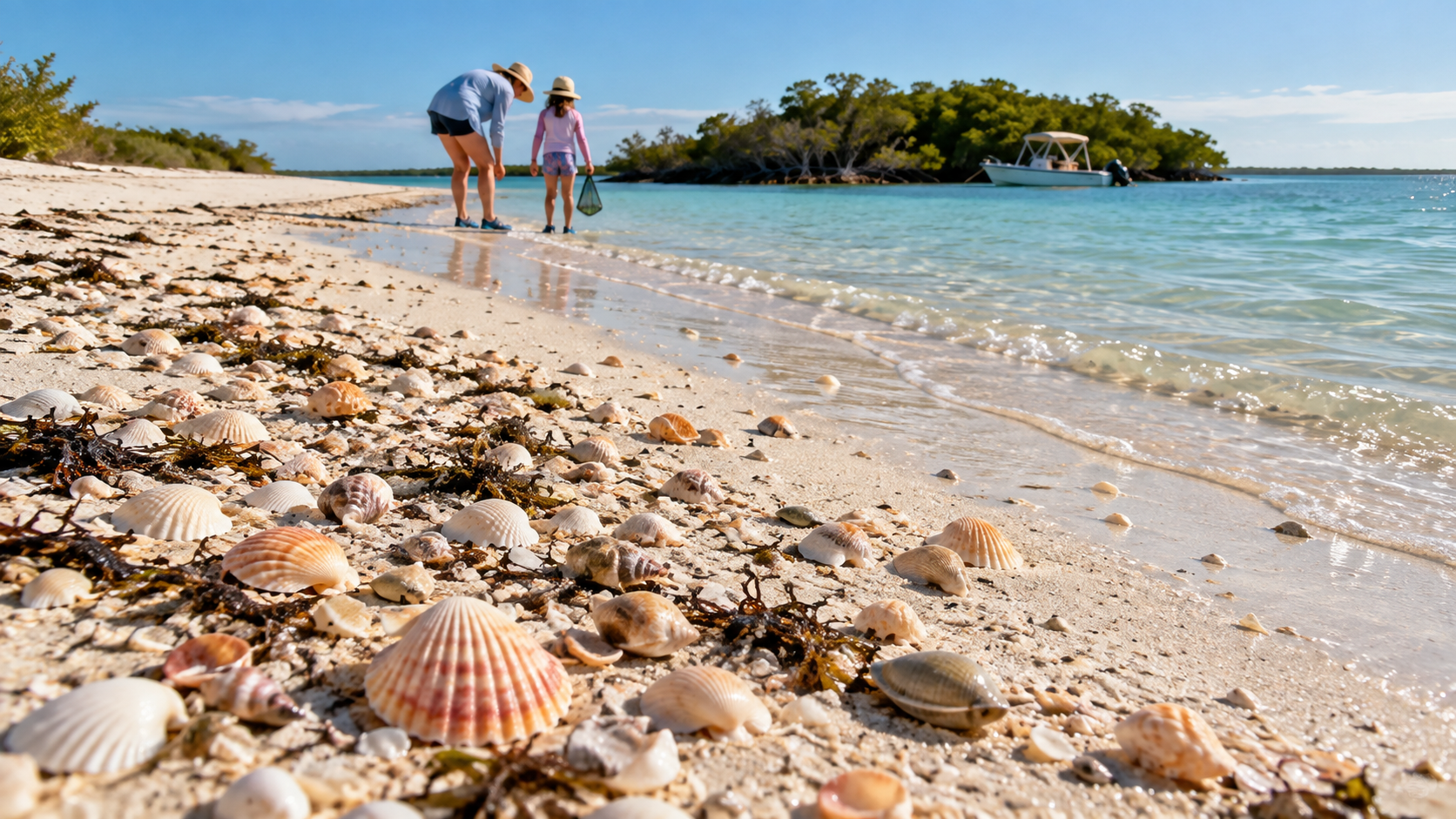
November 2026 Marco Island Shelling Forecast: Strong October Finds & Thanksgiving Low Tides
October shelling has been hot—and we’re talking about the finds.
At Treasure Seekers Shell Tours, we’ve been sharing examples from our trips on social media daily. The shelling has been exceptionally rewarding, the winds have been cooperative, and our crews have plenty to be excited about as November approaches.
We’re hoping this is the beginning of a winter for the record books. Nature will write that story, but the recent results have given us an encouraging start.
November adds another reason to look ahead: morning low-water opportunities early in the month and a deeper negative-tide stretch around Thanksgiving.
You don’t need to wait for the lowest tide to join the adventure. Wind, recent shell movement and knowing where to look all help shape a successful day.
Explore Treasure Seekers shelling tours near Marco Island.
We’re Out Every Day. That Experience Matters.
The Ten Thousand Islands change constantly. A productive shoreline can shift. A shell pocket can become covered. Another beach can begin collecting shells after a change in wind or current.
Our captains and guides are out every day with multiple tours. We see those changes firsthand and share what we’re learning across our crew.
That gives us recent, practical knowledge: where guests have been finding shells, how the water is behaving and which areas deserve another look.
A location that produced weeks ago isn’t automatically the right choice today. When choosing a shelling operator, ask how often its crew is actually on these waters—and look for recent examples of its trips.
Our daily social media updates give you a window into what our guests are finding. Those finds don’t guarantee tomorrow’s results, but they show the experience behind our recommendations.
Learn more about Treasure Seekers’ captains, guides and shelling adventures.
Cooperative Winds Are Part of the October Story
Our recent shelling is a reminder that you don’t need a hurricane to create exciting opportunities.
Wind direction, duration and strength can influence water levels and the shoreline available to explore. Recent waves and currents also help determine where empty shells accumulate.
Sustained offshore winds can move water away from the coast, allowing actual levels to fall below the tide prediction. Onshore winds can hold water against the shoreline.
NOAA explains this relationship in its guide to how wind and weather affect tides and coastal water levels.
For our Gulf-facing shores, easterly and northeasterly winds can have an offshore component. The effect varies with each island’s orientation and the broader conditions.
A moderate predicted low with favorable winds can offer more exposed shoreline than the chart alone suggests.
Stronger wind isn’t automatically better. Our captains also consider safe boating conditions, suitable island access and guest comfort.
We’ll assess November’s specific wind forecasts closer to each trip. For now, the tide calendar gives us useful planning windows.
November 1–7: Follow the Tide and Watch the Daylight
November begins with a late-morning low before the useful daytime low shifts into the afternoon.
Sunday, November 1
Low tide: 11:44 AM at 0.4 ft
Sunrise: 6:35 AM
Sunset: 5:45 PM
Monday, November 2
Afternoon low: 12:58 PM at 0.7 ft
Sunset: 5:44 PM
Tuesday, November 3
Afternoon low: 2:04 PM at 0.8 ft
Sunset: 5:44 PM
Wednesday, November 4
Afternoon low: 3:00 PM at 1.0 ft
Sunset: 5:43 PM
By November 5–7, the afternoon low moves later while the lower morning tide occurs before sunrise.
That’s where daylight, wind and current beach conditions become especially useful. Simply picking the lowest number in a 24-hour period won’t tell you what conditions will be like during your trip.
An afternoon departure can offer time on falling water, while morning trips may explore shoreline exposed during the earlier low. The best fit depends on the day and available departures.
Daylight saving time ends November 1. All times in this forecast are local Eastern Standard Time.
November 8–14: Morning Low-Water Opportunities
The next stretch brings low tides closer to sunrise and then farther into the morning.
Sunday, November 8
Low tide: 5:46 AM at 0.0 ft
Sunrise: 6:40 AM
Monday, November 9
Low tide: 6:23 AM at −0.1 ft
Sunrise: 6:40 AM
Tuesday, November 10
Low tide: 7:01 AM at −0.1 ft
Sunrise: 6:41 AM
Wednesday, November 11
Low tide: 7:38 AM at 0.0 ft
Sunrise: 6:42 AM
Thursday, November 12
Low tide: 8:15 AM at 0.1 ft
Sunrise: 6:43 AM
Friday, November 13
Low tide: 8:53 AM at 0.2 ft
Sunrise: 6:43 AM
Saturday, November 14
Low tide: 9:34 AM at 0.4 ft
Sunrise: 6:44 AM
November 9’s negative low occurs just 17 minutes before sunrise. November 10’s occurs 20 minutes after sunrise.
November 11–14 continue with low-water opportunities during morning daylight, even as the predicted heights gradually increase.
You don’t have to arrive on the beach at the exact minute of low tide. The surrounding falling- and rising-water periods can provide useful exploring time.
Our guided shelling tours in the Ten Thousand Islands pair that access with an on-island guide who helps guests search, identify shells and understand what they’re finding.
November 15–21: Keep Your Vacation Dates
Midmonth brings daytime lows moving from morning toward afternoon.
November 15 reaches 0.6 feet at 10:20 AM. November 16 follows with 0.7 feet at 11:16 AM, and November 17 brings a 0.9-foot low at 12:17 PM.
By November 18–21, the afternoon low moves from 1:16 PM to 3:44 PM. Sunset ranges from 5:36 to 5:35 PM during those dates, so departure time and trip length matter.
These dates remain worthwhile choices for a shelling adventure.
Shells can be found in waterline deposits, beach pockets and wrack lines left by previous tides. Favorable wind may also create additional shoreline access beyond the prediction.
If this is when you’re visiting Marco Island, don’t rule out a trip because Thanksgiving week has lower numbers.
Our recent October experience reinforces why we look beyond a tide chart. Conditions on the islands—and knowing where to explore—matter throughout the month.
For broader trip planning, visit our Marco Island shelling guide.
November 22–30: Thanksgiving Week’s Negative Tides
The month’s deepest predicted lows arrive during Thanksgiving week.
Sunday, November 22
Low tide: 4:35 AM at −0.1 ft
Sunrise: 6:50 AM
Monday, November 23
Low tide: 5:19 AM at −0.4 ft
Sunrise: 6:50 AM
Tuesday, November 24
Low tide: 6:05 AM at −0.7 ft
Sunrise: 6:51 AM
Wednesday, November 25
Low tide: 6:54 AM at −0.8 ft
Sunrise: 6:52 AM
Thursday, November 26 — Thanksgiving
Low tide: 7:44 AM at −0.8 ft
Sunrise: 6:53 AM
Friday, November 27
Low tide: 8:33 AM at −0.6 ft
Sunrise: 6:53 AM
Saturday, November 28
Low tide: 9:22 AM at −0.3 ft
Sunrise: 6:54 AM
Sunday, November 29
Low tide: 10:14 AM at 0.0 ft
Sunrise: 6:55 AM
Monday, November 30
Low tide: 11:11 AM at 0.4 ft
Sunrise: 6:56 AM
Sunset is approximately 5:35 PM throughout this stretch.
November 25 and Thanksgiving Day share the month’s lowest prediction at −0.8 feet. November 25’s low falls just two minutes after sunrise; Thanksgiving’s occurs 51 minutes after sunrise.
November 27–28 continue with negative lows farther into daylight. November 29–30 offer later morning lows as the cycle eases.
These dates are worth considering if you have flexibility and enjoy exploring extra exposed shoreline. Check available holiday departures early.
The listed times are low-tide times, not tour departure times.
Shelling in a Remarkable Coastal Ecosystem
Our trips take you beyond Marco Island’s developed shoreline and into a landscape of mangroves, tidal passes and natural barrier-island beaches.
Learn more about the region through the Ten Thousand Islands National Wildlife Refuge and Rookery Bay National Estuarine Research Reserve.
Understanding that environment adds another layer to the adventure. Every shell comes from a living ecosystem, and every visit is an opportunity to appreciate it.
Only empty shells come home. Living mollusks, hermit crabs, living sand dollars and other marine animals stay in their habitat.
Could This Be Your Junonia Trip?
That possibility is part of the excitement—but no tide or weather pattern guarantees a Junonia.
These distinctive shells originate offshore, and an intact empty shell reaching an accessible beach depends on a larger combination of currents, waves and chance.
Our complete Junonia shell guide explains identification, habitat and why finding one is so memorable.
Bring your wish list, but leave room for unexpected favorites.
Choose Your November Shelling Adventure
First-time shellers and guests who enjoy learning can choose a guided trip with an on-island shell guide.
Experienced shellers who prefer exploring independently can consider our self-guided shelling tours, with the captain transporting guests and remaining nearby.
For a private boat experience with an on-island guide, explore our private shelling tours near Marco Island.
Not sure which fits? Read our guided versus self-guided shelling tour comparison.
Bring water shoes, a shell bag or bucket, sun protection and a light jacket for cooler boat rides. We provide complimentary water and iced tea.
Join Us on the Islands This November
October has given us an exciting start. Cooperative winds, rewarding finds and daily time on the islands have our crew looking forward to what comes next.
November brings its own opportunities—from early-month morning lows to Thanksgiving’s negative tides and all the changing conditions between them.
Choose a crew whose knowledge is being refreshed on the water every day.
Compare Treasure Seekers shelling tours and check November availability.
Forecast notes: Tide predictions, sunrise and sunset times are from the supplied US Harbors November 2026 chart for Marco Island, Caxambas Pass. All times are local Eastern Standard Time. Actual water levels and conditions vary with wind, weather and location. Recent trip results describe our experience, not a guarantee of future finds. Tour departures and destinations depend on availability and conditions.